THEOS WELLNESS
Chamomile (Matricaria recutita and Chamaemelum nobile)
Traditional Herbal Wisdom, Modern Research, and Responsible Use
THEOS Wellness Herbal Monograph Series
Educational and Medical Disclaimer
This guide is for education and describes traditional herbal use, published research, and practical preparations. It is not individualized medical advice. For a child, pregnancy or breastfeeding, medication interactions, or a persistent health concern, consult an appropriate healthcare professional. Use each commercial product according to its current label.
Quick Facts
| Topic | At a glance |
|---|---|
| Two commonly used species | German chamomile: Matricaria recutita; Roman chamomile: Chamaemelum nobile |
| Plant part | Flower heads |
| Common forms | Tea bags, loose flowers, liquid extracts, infused oil, salve, and essential oils |
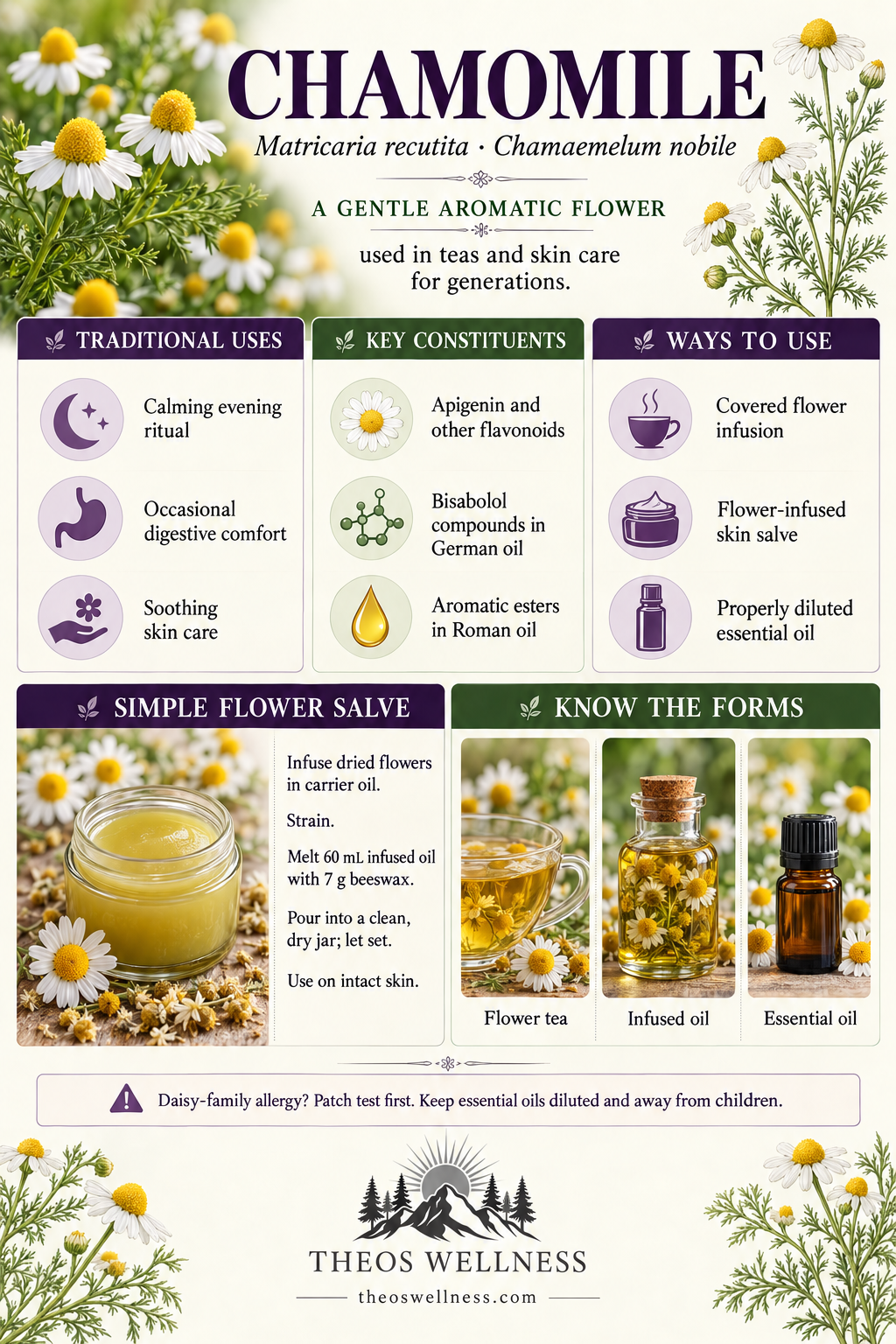
| Traditional affinities | Relaxation, occasional digestive comfort, and soothing skin care |
| Notable constituents | German flower: apigenin derivatives; German oil: bisabolol compounds and chamazulene; Roman oil: aromatic esters |
| Key safety point | Check daisy-family allergies; dilute essential oils and keep them away from children's mouths and eyes |
Introduction: A Familiar Flower with Many Forms
Chamomile's small, fragrant flowers have been part of tea and skin-care traditions for generations. A warm infusion is often chosen for a peaceful evening or digestive comfort; flower-infused oil can become a soothing salve; and German and Roman chamomile essential oils bring their distinct aromas to carefully diluted skin-care blends. Here is how to enjoy each form, what researchers have found, and how to use chamomile thoughtfully.
This guide follows the flower from cup to skin care. It also separates flower tea and infused oil from concentrated essential oil and from the specific extracts used in research.
1. Botanical Identity: German and Roman Chamomile
German chamomile (Matricaria recutita, also called M. chamomilla) is the species in our loose Chamomile Flower and the Traditional Medicinals Organic Chamomile Tea. Its flower heads are used for tea and can also be infused into oil for a salve. Roman chamomile (Chamaemelum nobile, synonym Anthemis nobilis) is a different species. Both yield essential oils, but their chemical profiles and aromas differ. THEOS carries both German chamomile essential oil and Roman chamomile essential oil (European Medicines Agency [EMA], 2016a, 2016b).
2. The Herbalist's Perspective
Herbalists have long reached for chamomile when a gentle aromatic flower suits the moment: a warm cup after a meal, a quiet evening ritual, or a soothing addition to skin care. The terms below describe the traditional uses more precisely.
- Relaxing nervine: A traditional term for an herb used to ease nervous tension and support a calmer routine. Chamomile tea is a familiar evening ritual; clinical research has also explored a specific German chamomile extract for anxiety symptoms.
- Carminative: An aromatic herb traditionally used for digestive comfort, especially a feeling of fullness, gas, or bloating after a meal.
- Antispasmodic: A term for easing cramp-like tension. German chamomile flower has a traditional use for mild gastrointestinal spasms.
- Skin soothing: Flower infusions and appropriately formulated chamomile skin products have a history of use for minor skin discomfort. A plain flower salve offers an easy way to moisturize intact skin.
Together, these traditional properties help explain chamomile's place in tea, herbal extracts, and botanical skin care (EMA, 2016a, 2016c).
3. The Constituents Behind the Aroma
German chamomile flowers contain flavonoids such as apigenin derivatives as well as aromatic constituents. Steam-distilled German chamomile oil may feature α-bisabolol, bisabolol oxides, and chamazulene, with the proportions varying by batch. Roman chamomile essential oil has a different, ester-rich profile that may include methallyl angelate and 3-methylpentyl angelate. Laboratory research on α-bisabolol and chamazulene has explored inflammation-related pathways, providing a useful constituent-level rationale for chamomile skin care; the experience with a finished product also depends on the whole formulation (EMA, 2016a, 2016b; Maurya et al., 2014; Safayhi et al., 1994; Sándor et al., 2018).
Why the preparation matters
Hot water draws out a different mix of constituents than a dropper extract, a flower-infused carrier oil, or steam distillation. A clinical result for an oral extract should be read as evidence about that studied extract; a constituent experiment can help explain interest in an oil without assigning the same effect to every finished product.
4. Relaxation, Sleep, and Digestive Comfort: What Research Says
In an eight-week, placebo-controlled trial of German chamomile extract, 57 people with mild to moderate generalized anxiety disorder were randomized. The researchers reported a “significantly greater reduction in mean total HAM-A score during chamomile versus placebo therapy” (Amsterdam et al., 2009). This suggests that the studied oral extract may help with anxiety symptoms and gives researchers a promising reason to continue studying chamomile.
A 2019 review of 12 randomized trials found encouraging results for anxiety measures and sleep quality. Its authors reported “a significant improvement in sleep quality after chamomile administration” (Hieu et al., 2019). The trials explored several preparations, making sleep quality a particularly interesting area for further study. In a separate 80-person trial, postpartum women who drank chamomile tea for two weeks reported better scores on a sleep-related measure than controls immediately afterward; the benefit was short term in this study (Chang & Chen, 2016).
What this means in everyday use: German chamomile has a long tradition for digestive comfort and relaxation. Human studies add encouraging findings for anxiety symptoms with an oral extract and for sleep quality across several preparations, including a small tea trial. Each study tells us which preparation was used and what benefit was measured (EMA, 2016a; Amsterdam et al., 2009; Hieu et al., 2019; Chang & Chen, 2016).
The strongest clinical detail for anxiety in this article concerns a German chamomile oral extract, while the tea studies address a familiar beverage. For digestion, the European Medicines Agency documents the traditional use of German chamomile flower infusion for mild bloating and spasms. These are useful distinctions when choosing a form (EMA, 2016c).
5. Chamomile Preparations at THEOS Wellness
Tea bags, loose flowers, and liquid extracts
The most familiar use is an infusion of German chamomile flowers. In herbal traditions, people have enjoyed chamomile tea for a calming evening ritual and occasional digestive comfort. The EMA recognizes German chamomile flower infusion as a traditional preparation for minor digestive complaints such as bloating and spasms. Research on chamomile has also explored relaxation and sleep quality, as discussed below (EMA, 2016a; Hieu et al., 2019).
For convenience, Traditional Medicinals Organic Chamomile Tea uses German chamomile flower in tea bags. The manufacturer's directions are one bag in 8 ounces of freshly boiled water, covered for 5–10 minutes. The product at THEOS is a case of six boxes, 16 bags per box; check the current listing and package before purchasing or using it (Traditional Medicinals, n.d.).
Loose-flower tea method for adults and adolescents 12+: Weigh 1.5–4 g of loose German Chamomile Flower for each 150 mL / 5 fl oz boiling water. Cover, steep 5–10 minutes, then strain. The EMA monograph describes this infusion 3–4 times daily for traditional digestive use; for a simple cup, start at the lower end and adjust to taste. A small scale is helpful because whole and cut flowers fill a spoon differently (EMA, 2016c).
For a daily ritual, enjoy the warm tea after a meal or during a quiet evening. Taste after five minutes; a longer steep can bring out more of chamomile's pleasantly bitter side. Covering the cup while it steeps helps keep its aroma in the tea. Brew a fresh cup rather than leaving wet flowers at room temperature.
We also carry Chamomile Flower Extract, 1 oz and Organic Chamomile Flower Extract, 1 oz. These are more concentrated, separately labeled preparations. Follow their own serving directions and check the extraction ingredients, especially if avoiding alcohol or taking medication.
Flower infusions and essential oils for skin care
Steeping dried flowers in a carrier oil makes a fragrant flower infusion for salves. Distilling the flowers makes a much more concentrated essential oil for diluted aromatic blends. Chamomile flower preparations have a long history in skin care. The EMA describes traditional topical use for minor skin irritation, while a small randomized comparison found a modest benefit from a chamomile-extract cream for atopic skin (EMA, 2016a; Patzelt-Wenczler & Ponce-Pöschl, 2000). At home, a flower-infused salve is a lovely way to moisturize and comfort intact skin.
Robert Tisserand observes that “Essential oils can calm irritation or inflammation.” Dilution is central to making an aromatic blend comfortable for skin, particularly when formulating for sensitive areas (Tisserand, n.d.-a).
Our German Chamomile Essential Oil (Matricaria recutita) has a deeper, herbaceous aroma; Roman Chamomile Essential Oil (Chamaemelum nobile) is often described as softer and fruitier. Both can scent an adult massage oil or a cosmetic skin blend when properly diluted. For a cautious adult leave-on blend, start around 0.5% essential oil by weight—for example, 0.5 g essential oil in 99.5 g carrier oil or finished balm. Tisserand explains that “no two drops of essential oil are the same,” which is why a small digital scale is useful for a batch (Tisserand, n.d.-a). Patch test first, avoid eyes and mucous membranes, and stop if irritation develops. Do not apply essential oils undiluted or ingest them (Tisserand Institute, n.d.; Poison Control, n.d.).
An aromatherapist's lens: Start with the botanical species and, when available, the batch's GC/MS profile. A German chamomile oil rich in bisabolol derivatives and an ester-rich Roman chamomile oil offer different aromatic starting points. Then consider the child's age, the purpose and area of application, skin condition, exposure frequency, and the final dilution. Their constituent profiles make both oils worth considering for carefully formulated, age-appropriate aromatic use, while the amount in the finished blend determines much of its skin exposure. Robert Tisserand emphasizes that dilution and risk are directly linked (Tisserand Institute, n.d.).
A simple cooled compress: Steep 1.5 g dried German chamomile flowers in 150 mL boiling water for 10 minutes, covered. Strain through a fine filter and let the tea cool completely. Moisten a clean cloth and rest it on a small area of intact skin for 5–10 minutes. Make a fresh infusion each time, patch test first, and keep it away from the eyes. This offers a refreshing, flower-scented step in a gentle skin-care routine (EMA, 2016a).
The EMA also documents traditional topical use of specified German chamomile essential oil preparations for adults and adolescents 12 and older (EMA, 2016b).
6. Make a Simple Chamomile Flower Salve
This small, flower-infused salve moisturizes intact skin and carries chamomile's soft aroma. Use thoroughly dried flowers so the oil stays fresh.
Ingredients
- About ¼ cup completely dried Chamomile Flower
- About ½ cup olive oil or another plain, skin-compatible carrier oil, enough to cover the flowers
- 60 mL strained chamomile-infused oil from that infusion
- 7 g beeswax pellets (approximately 2 teaspoons by volume, but weigh for consistency)
- One clean, completely dry 2–3 oz jar or tin
Method
- Place the dried flowers in a clean, dry heat-safe jar. Add enough carrier oil to cover them. Set the jar in a gently heated water bath for about 1–2 hours; keep water out of the jar and avoid frying or boiling the oil. Allow it to cool, then strain thoroughly through clean cloth or a fine filter.
- Measure 60 mL of the strained oil. In a double boiler, warm it with 7 g beeswax just until the wax melts. Stir and pour into the dry jar or tin.
- Let it set completely. Label the ingredients and date. Store closed in a cool place; discard it if it develops an off smell, mold, moisture, or a change in appearance.
- After a patch test, smooth a small amount onto intact areas of dry skin. For an infected area, serious burn, deep wound, or unexplained rash, seek appropriate care.
The flowers supply the aroma in this beginner recipe. Adults who want to create a version with essential oil can calculate a suitable dilution by weight in the finished batch and follow that oil's label. Make the flower-only version when preparing salve for a family skin-care routine; discuss infant or young-child use with a pediatric clinician.
7. Chamomile in a Family Routine
Chamomile is more than a sleepy-time tea. Families have traditionally turned to its fragrant flowers for a quiet moment after a busy day and for occasional tummy discomfort. Its gentle apple-like aroma and slightly bitter flavor can also introduce an older child to the idea that a plant can be enjoyed in several forms: as a flower to observe, a warm infusion to taste, or a fragrant ingredient in a simple skin-care preparation.
For winding down: Preparing a cup together can become part of a calm evening routine. Let the tea cool before offering it to an older child, and enjoy the aroma, the taste, and a few minutes of quiet. Studies of chamomile and sleep are encouraging, although the published trials largely involve adults and several different preparations (Hieu et al., 2019).
For occasional digestive comfort: Herbalists call chamomile carminative and antispasmodic because of its traditional use for gas, fullness, and cramp-like digestive discomfort. The EMA includes German chamomile flower tea among its traditional preparations for minor gastrointestinal complaints and provides age-specific amounts. Ask your child's pediatrician which preparation and amount fit their age and situation (EMA, 2016c).
For everyday skin care: The flower-infused salve above offers a botanical way to moisturize intact skin. Patch test a small area first, especially in a child with sensitive skin or allergies to daisy-family plants. A cool, freshly prepared flower compress can also be a pleasant skin-care ritual for an older child; keep it away from the eyes. For a rash, eye redness, or skin that seems infected, a pediatrician can identify the cause and guide care (EMA, 2016a; American Academy of Pediatrics [AAP], 2016).
For aromatic enjoyment: A child can smell dried chamomile flowers or participate in preparing tea without handling an essential-oil bottle. Essential-oil choices depend on age, route, dilution, and the child's health. Hana Tisserand notes that “Using hydrosols instead of essential oils is a safer option for children under 6 years of age” (Tisserand, 2017). A hydrosol is a separate, much less concentrated aromatic water. Keep essential-oil bottles locked away (Poison Control, n.d.).
What infant studies have explored
Colic and crying: In one placebo-controlled trial, 90 breastfed infants completed a week of care with a German chamomile flower preparation in carrier oil or a placebo oil. Crying and fussing were lower in the chamomile group. Both groups also received simethicone. The investigators made their preparation by extracting dried flowers and transferring the extract into oil; they used GC/MS to characterize a volatile fraction, which included bisabolol oxides and chamazulene. This is encouraging evidence for the studied flower-oil preparation. It was an infused/extracted oil, not a bottle of steam-distilled essential oil, and nine enrolled infants had skin redness to the test oils during screening or follow-up (Mohamadi Sorme et al., 2020). An earlier small trial also reported improvement with a tea containing chamomile alongside several other herbs (Weizman et al., 1993).
Teething discomfort: A preliminary double-blind study involving 62 infants aged 6–12 months reported improvement in teething symptoms, especially pain-related irritability, with a topical chamomile water extract compared with placebo. This finding was published as a conference abstract, so the available report gives limited preparation and safety details. It points to a promising research question about the flower extract, rather than a method for putting essential oil on a baby's gums (Ebrahimi & Ashkani, 2008).
Diaper rash: In a double-blind study of 90 infants younger than one year, both chamomile ointment and calendula ointment improved diaper-rash scores over a week. The chamomile group's score was lower on day three, while both groups' mean scores reached zero by day seven. This offers a specific example of chamomile in a formulated infant skin-care product; the study did not evaluate our homemade flower salve or an essential-oil blend (Afshari et al., 2015).
These studies offer useful reasons to keep investigating chamomile for family care. For an individual infant, preparation, skin response, feeding, and the reason for crying or rash all matter; a pediatric clinician can help guide the choice. For teething comfort, the FDA also describes gentle gum massage with a clean finger or a firm rubber teether (FDA, 2024).
Infants: Ask the infant's clinician before offering chamomile tea or applying a chamomile product to a baby. For babies younger than six months, breast milk or infant formula supplies their usual fluids. A clinician can help identify the cause of persistent crying, feeding trouble, fever, rash, or sleep concerns and advise on appropriate care. Keep essential oils away from an infant's mouth, face, and reach (Centers for Disease Control and Prevention [CDC], n.d.; NCCIH, 2024; Poison Control, n.d.).
Essential oils at any age: Use essential oils as concentrated aromatics, diluted in an appropriate carrier for skin use. Keep them out of drinks and away from eyes and mouths; drops of oil require proper dispersal before any bath use. If a child swallows an essential oil, call Poison Control at 1-800-222-1222 in the United States (Tisserand Institute, n.d.; Poison Control, n.d.).
8. Safety by Form and Age
Allergy: Chamomile belongs to the daisy family (Asteraceae). People allergic to ragweed, daisies, chrysanthemums, or related plants may react to chamomile. Reactions can be severe. Stop use for rash, swelling, wheezing, or other concerning symptoms; seek emergency care for breathing difficulty (NCCIH, 2024).
Tea and extracts for adults: Enjoy tea in ordinary food-like amounts and seek individualized guidance for medicinal-dose use. Check with a healthcare professional if you take warfarin, sedatives, or other medications, or if you are pregnant or breastfeeding; chamomile may interact with some medicines, and pregnancy and breastfeeding safety information is limited (NCCIH, 2024).
For essential oils, use the specific species and current label, and check any batch information when available. For infants and children, the flower-only salve or a hydrosol may be a more suitable starting point for discussion with their clinician than a homemade essential-oil blend.
9. Frequently Asked Questions
Are German and Roman chamomile the same plant?
No. They are two species with different aromatic profiles. German chamomile flower is used for the tea and loose flower linked here; both species are sold as essential oils.
How much loose chamomile should I use for tea?
For adults and adolescents 12 and older, the EMA describes 1.5–4 g German chamomile flower per 150 mL (5 fl oz) boiling water, covered for 5–10 minutes. The article's tea section explains the traditional frequency and preparation.
Can I put chamomile essential oil straight into tea or a bath?
Essential oil is concentrated and does not disperse evenly in plain water. Keep it out of drinks; use a properly formulated product or an appropriately diluted skin blend for the intended route.
Can a flower salve be made without essential oil?
Yes. The recipe above uses only thoroughly dried chamomile flowers infused in carrier oil, plus beeswax. That is the simplest version.
What about chamomile for babies?
The infant studies examined particular flower extracts, a tea blend, and a formulated ointment. A pediatric clinician can help interpret the child's age, symptoms, skin response, and the preparation; do not treat the steam-distilled essential oil as equivalent to the flower preparation used in the colic trial.
10. THEOS Wellness Perspective
Chamomile makes sense when its species, preparation, and purpose are clear. A warm German chamomile tea suits a calming ritual and traditional digestive comfort. Flower-infused oil becomes a simple salve. German and Roman essential oils offer different aromas for carefully diluted skin care. Published research gives an encouraging look at oral extracts, sleep quality, and specific topical preparations while helping us choose words that fit the evidence.
In Closing
The small flower offers several distinct ways to explore herbal practice. Start with the form that suits your purpose, prepare it carefully, and consider age, allergies, medication use, and skin sensitivity. At THEOS Wellness, our chamomile tea, loose flowers, flower extracts, and German and Roman essential oils make it possible to compare those forms directly.
References
Afshari, Z., Jabraeili, M., Asaddollahi, M., Ghojazadeh, M., & Javadzadeh, Y. (2015). Comparison of the effects of chamomile and calendula ointments on diaper rash. Evidence Based Care, 5(2), 49–56. https://doi.org/10.22038/ebcj.2015.4544
American Academy of Pediatrics. (2016, February 2). Eye infections in infants & children. HealthyChildren.org. https://www.healthychildren.org/English/health-issues/conditions/eyes/Pages/Eye-Infections.aspx
Amsterdam, J. D., Li, Y., Soeller, I., Rockwell, K., Mao, J. J., & Shults, J. (2009). A randomized, double-blind, placebo-controlled trial of oral Matricaria recutita (chamomile) extract therapy for generalized anxiety disorder. Journal of Clinical Psychopharmacology, 29(4), 378–382. https://doi.org/10.1097/JCP.0b013e3181ac935c
Baranauskienė, R., Venskutonis, P. R., & Ragažinskienė, O. (2022). Valorisation of Roman chamomile (Chamaemelum nobile L.) herb by comprehensive evaluation of hydrodistilled aroma and residual non-volatile fractions. Food Research International, 160, 111715. https://doi.org/10.1016/j.foodres.2022.111715
Centers for Disease Control and Prevention. (n.d.). About feeding from a bottle. https://www.cdc.gov/infant-toddler-nutrition/bottle-feeding/index.html
Chang, S.-M., & Chen, C.-H. (2016). Effects of an intervention with drinking chamomile tea on sleep quality and depression in sleep disturbed postnatal women: A randomized controlled trial. Journal of Advanced Nursing, 72(2), 306–315. https://doi.org/10.1111/jan.12836
European Medicines Agency. (2016a). Matricariae flos—Herbal medicinal product. https://www.ema.europa.eu/en/medicines/herbal/matricariae-flos
European Medicines Agency. (2016b). Matricariae aetheroleum—Herbal medicinal product. https://www.ema.europa.eu/en/medicines/herbal/matricariae-aetheroleum
European Medicines Agency. (2016c). European Union herbal monograph on Matricaria recutita L., flos. https://www.ema.europa.eu/en/documents/herbal-monograph/final-european-union-herbal-monograph-matricaria-recutita-l-flos-first-version_en.pdf
Ebrahimi, S., & Ashkani, S. (2008). A comparison of chamomile and placebo in relieving teething symptoms [Conference abstract]. Archives of Disease in Childhood, 93(Suppl. 2), pw308. https://adc.bmj.com/content/93/Suppl_2/pw308
Food and Drug Administration. (2024, June 26). Safely soothing teething pain in infants and children. https://www.fda.gov/consumers/consumer-updates/safely-soothing-teething-pain-infants-and-children
Sándor, Z., Mottaghipisheh, J., Veres, K., Hohmann, J., Bencsik, T., Horváth, A., Kelemen, D., Papp, R., Barthó, L., & Csupor, D. (2018). Evidence supports tradition: The in vitro effects of Roman chamomile on smooth muscles. Frontiers in Pharmacology, 9, 323. https://doi.org/10.3389/fphar.2018.00323
Hieu, T. H., Dibas, M., Dila, K. A. S., Sherif, N. A., Hashmi, M. U., Mahmoud, M., Trang, N. T. T., Abdullah, L., Nghia, T. L. B., Y, M. N., Hirayama, K., & Huy, N. T. (2019). Therapeutic efficacy and safety of chamomile for state anxiety, generalized anxiety disorder, insomnia, and sleep quality: A systematic review and meta-analysis of randomized trials and quasi-randomized trials. Phytotherapy Research, 33(6), 1604–1615. https://doi.org/10.1002/ptr.6349
National Center for Complementary and Integrative Health. (2024). Chamomile: Usefulness and safety. https://www.nccih.nih.gov/health/chamomile
Maurya, A. K., Singh, M., Dubey, V., Srivastava, S., Luqman, S., & Bawankule, D. U. (2014). α-(-)-Bisabolol reduces pro-inflammatory cytokine production and ameliorates skin inflammation. Current Pharmaceutical Biotechnology, 15(2), 173–181. https://doi.org/10.2174/1389201015666140528152946
Mohamadi Sorme, F., Tabarra, M., Alimadady, H., Rahimi, R., Sepidarkish, M., & Karimi, M. (2020). Efficacy of Matricaria chamomilla L. in infantile colic: A double-blind, placebo-controlled randomized trial. Journal of Pharmaceutical Research International, 31(6), 1–11. https://doi.org/10.9734/jpri/2019/v31i630385
Patzelt-Wenczler, R., & Ponce-Pöschl, E. (2000). Proof of efficacy of Kamillosan® cream in atopic eczema. European Journal of Medical Research, 5(4), 171–175. https://pubmed.ncbi.nlm.nih.gov/10799352/
Poison Control. (n.d.). Essential oils: Poisonous when misused. https://www.poison.org/articles/essential-oils
Safayhi, H., Sabieraj, J., Sailer, E.-R., & Ammon, H. P. T. (1994). Chamazulene: An antioxidant-type inhibitor of leukotriene B4 formation. Planta Medica, 60(5), 410–413. https://doi.org/10.1055/s-2006-959520
Tisserand Institute. (n.d.). How to use essential oils safely. https://tisserandinstitute.org/safety-guidelines/
Tisserand, H. (2017, March 8). Hydrosols for children. Tisserand Institute. https://tisserandinstitute.org/learn-more/hydrosols-children-safety/
Tisserand, R. (n.d.-a). Dilution for essential oils. Tisserand Institute. https://tisserandinstitute.org/dilution-essential-oils/
Tisserand, R. (n.d.-b). Five steps to successfully using essential oils in skin care. Tisserand Institute. https://tisserandinstitute.org/five-steps-to-successfully-using-essential-oils-in-skin-care/
Traditional Medicinals. (n.d.). Chamomile tea. https://www.traditionalmedicinals.com/products/chamomile-tea
Weizman, Z., Alkrinawi, S., Goldfarb, D., & Bitran, C. (1993). Efficacy of herbal tea preparation in infantile colic. The Journal of Pediatrics, 122(4), 650–652. https://doi.org/10.1016/S0022-3476(05)83557-7
