THEOS WELLNESS
Five Essential Oils for the Home
A practical guide to their aromas, everyday uses, natural chemistry, and thoughtful application.
Opening an essential oil bottle can bring a plant’s character into focus: lavender’s soft floral scent, peppermint’s crisp mint, or frankincense’s warm resinous notes. A small collection makes it easier to learn those differences and find the aromas you actually enjoy.
Lavender, peppermint, tea tree, frankincense, and eucalyptus offer a useful starting point. Each has a different composition and a different place in home aromatherapy. You do not need all five, and no oil is suitable for every person or purpose.
This guide explains what each oil brings to a routine, where research offers useful clues, and how to keep preparation and safety in view. The practical examples are for adults; children need separate, oil-specific guidance.
The five oils at a glance
| Oil | Aroma | Everyday role | Key constituents |
|---|---|---|---|
| Lavender | Floral and softly herbal | Evening aromatherapy | Linalool, linalyl acetate |
| Peppermint | Sharp, minty, cooling | Fresh daytime aroma; formulated cooling products | Menthol, menthone |
| Tea tree | Medicinal and woody | Formulated skin care | Terpinen-4-ol, gamma-terpinene, alpha-terpinene |
| Frankincense | Resinous, citrusy or woody | Quiet-time fragrance and massage aroma | Often alpha-pinene; composition varies by species |
| Eucalyptus | Penetrating and fresh | Adult aromatic routines | Often 1,8-cineole in globulus and radiata oils |
The constituents listed are examples, not a batch specification. Species, growing conditions, extraction, and storage influence composition. A batch-specific analytical report provides more detail than the common name alone.
1. Lavender for an evening wind-down
Look for: Lavandula angustifolia. Other lavender species and lavandin can have different scent and constituent profiles.
Lavender’s familiar floral aroma makes it an approachable first oil. Linalool and linalyl acetate are commonly prominent constituents, and their balance helps shape its soft, herbal character.
Some studies suggest lavender aromatherapy may help relaxation or sleep-related experiences, but results vary and research has limitations. Studies of a manufactured oral lavender preparation do not establish that inhaling lavender or swallowing a bottle sold for aromatherapy produces the same effect. NCCIH’s lavender overview explains these distinctions.
Try it at home: Use a low-intensity aroma during a quiet evening activity, following the diffuser’s instructions. Pair the routine with softer lighting and a regular bedtime rather than expecting fragrance to solve persistent sleep difficulties. A ready-made, appropriately diluted lavender massage product is another option for adults who tolerate fragrance.
Keep in mind: Lavender can cause skin allergy, headache, or coughing in some people. Stop if it feels uncomfortable.
2. Peppermint for cooling sensation and crisp freshness
Look for: Mentha × piperita.
Peppermint is immediately recognizable. Menthol activates cold-sensitive receptors, helping explain its cooling sensation; menthone contributes to the minty aromatic profile. Cooling perception does not necessarily mean the skin’s temperature has fallen.
Limited human evidence suggests certain topical peppermint preparations may help tension headaches. Separate research supports enteric-coated peppermint oil capsules for some adult IBS symptoms. Those capsules are purpose-made oral products, not instructions to drink essential oil or add it to water. See NCCIH’s peppermint oil overview.
Try it at home: Enjoy a brief, low-intensity daytime aroma, or choose a labeled, pre-diluted cooling massage product for intact skin. A refreshing scent may suit your workspace, but it does not guarantee improved concentration.
Keep in mind: Avoid eyes, nostrils, and sensitive skin. Do not expose infants or small children to concentrated menthol inhalation or apply it to their faces. Peppermint preparations taken orally can worsen reflux.
3. Tea tree for purposeful skin-care choices
Look for: Melaleuca alternifolia.
Tea tree has a medicinal, slightly woody scent. Terpinen-4-ol is an important constituent, and laboratory studies have investigated the oil’s activity against microorganisms. Laboratory activity is useful scientific information, but it does not make a homemade blend a proven infection treatment or household disinfectant.
Small clinical studies have investigated formulated tea tree products for acne and some fungal skin conditions. Evidence remains limited. For example, a randomized acne trial tested a specific 5% gel; its findings do not validate an arbitrary DIY recipe.
Try it at home: Choose a formulated tea tree skin-care product intended for your concern and follow its label. This is more predictable than guessing at a concentration or applying neat oil.
Keep in mind: Never swallow tea tree oil. It can cause irritation or allergy, especially as it oxidizes. Do not put it on scrapes or open wounds; those need ordinary wound care. Read NCCIH’s tea tree guidance.
4. Frankincense for resinous aroma and quiet routines
Look for: The exact Boswellia species, such as B. sacra, B. carterii, or B. serrata.
Frankincense essential oil is distilled from resin. Its aroma may be bright and citrusy, woody, or warmly balsamic. Alpha-pinene is often prominent, but there is substantial variation between species and batches.
A key distinction is that frankincense essential oil and Boswellia resin extracts are different preparations. Boswellic acids are nonvolatile resin compounds and are not expected in appreciable amounts in ordinarily distilled essential oil. Research on boswellic-acid extracts for joint symptoms cannot simply be transferred to a frankincense diffuser or massage blend. The Tisserand Institute discusses this chemistry.
Try it at home: Use its fragrance during reading, reflection, or meditation, or as the aromatic component of an appropriately diluted adult massage blend. “Grounding” describes a personal sensory experience rather than a demonstrated treatment effect.
Keep in mind: A low price alone cannot establish adulteration, and a high price cannot establish purity. Look for botanical identification, sourcing information, and meaningful batch testing.
5. Eucalyptus for a fresh adult aromatic routine
Look for: The species and intended use. Eucalyptus globulus and E. radiata commonly contain substantial 1,8-cineole, also called eucalyptol. Other eucalyptus oils may have different chemistry.
Eucalyptus’s penetrating scent explains its popularity in cold-season aromatic products. A fresh breathing sensation is not proof that airways have opened, an infection has improved, or asthma is being treated. Research on an oral cineole medicine also does not validate household inhalation recipes.
Try it at home: Adults who tolerate it can follow the instructions on a diffuser-compatible oil or a formulated topical product. Keep the aroma low and the room ventilated.
Keep in mind: Do not swallow eucalyptus oil. Avoid towel-over-the-head bowls of hot water, which add a scald risk, particularly around children. Eucalyptus can irritate breathing passages and is not a routine choice for infants or young children. Poison Control provides detailed safety information.
Dilution is about the whole blend
A carrier oil, such as jojoba or sunflower oil, dilutes essential oil for skin application. Water does not perform that job. A blend’s percentage refers to the combined amount of all essential oils in the finished mixture.
For example, 1% lavender plus 1% frankincense makes a 2% total blend. It is not a 1% blend simply because each oil was measured separately.
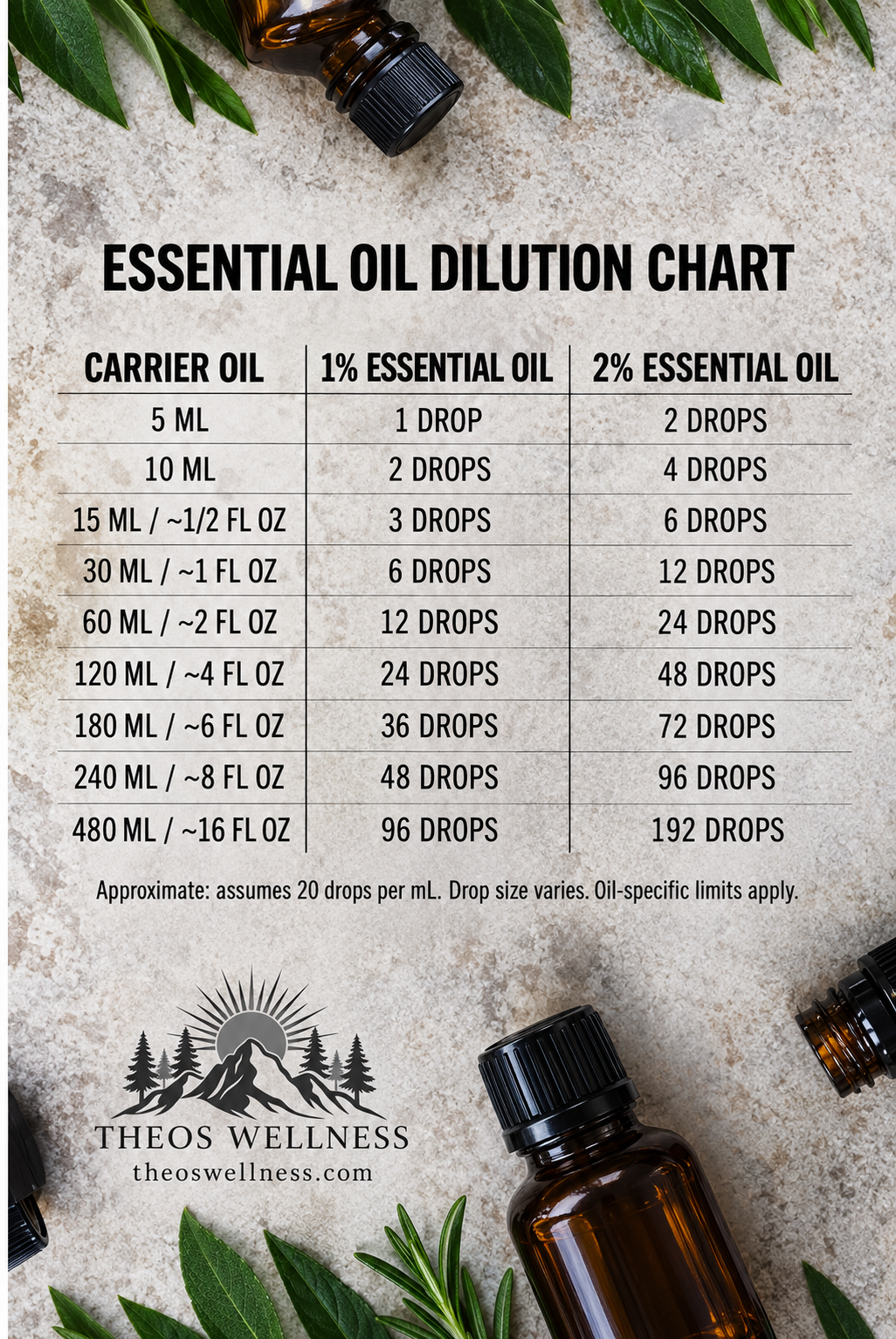
For an adult beginning with an oil appropriate for the intended skin area, a low concentration such as 0.5–1% may be a useful starting point. This is not a universal safety limit: some oils have stricter limits, and some people should avoid fragrance entirely. Follow product-specific guidance.
| Illustrative concentration | Essential oil volume | Carrier oil volume | Finished blend |
|---|---|---|---|
| 0.5% | 0.15 mL | 29.85 mL | 30 mL |
| 1% | 0.30 mL | 29.70 mL | 30 mL |
These are arithmetic examples for adults, not pediatric prescriptions. Drop counts are approximate because drop size varies. Measuring accurately or selecting a pre-diluted product removes some of that uncertainty. See the Tisserand Institute’s dilution explanation.
A simple approach to mixing and storage
- Choose an oil suitable for your purpose and check its label and safety guidance.
- Measure the carrier and essential oil into a clean container. Do not count drops into your palm and assume the concentration is known.
- Close and mix gently. There is no need to claim that ordinary shaking instantly ruins a blend.
- Label the ingredients, total concentration, and mixing date. Store tightly closed, away from heat and light.
- Follow shelf-life guidance for the ingredients. A fixed three-month expiry does not fit every blend.
A small-area trial may help identify irritation, but it cannot guarantee against delayed allergy. If a rash or irritation develops, stop and wash the area with mild soap and water. Do not use more carrier oil as the only first-aid response. Poison Control explains appropriate precautions.
Children need individual guidance
An adult’s favorite oil is not automatically appropriate for a child. Oil identity, concentration, age, route, exposure time, and health history all matter. Lowering the percentage alone does not make every oil suitable.
Do not use this article’s adult examples for infants or children. Ask a pediatric healthcare professional about any proposed use, especially with asthma, eczema, seizures, medication use, or fragrance sensitivity. A commercial product should be specifically appropriate for the child’s age and used exactly as labeled.
Keep bottles and diffuser liquids locked away. Avoid using concentrated oils around babies, putting oils near a child’s nose or mouth, or running a diffuser all night. Do not apply oils to children’s scrapes or substitute them for care of breathing difficulties or infection.
Diffusers, baths, and cleaning are different uses
Diffusion: Follow the device instructions, start with the lowest suggested amount, use ventilation, and take breaks. Consider everyone sharing the room, including pets. Stop if anyone develops coughing, headache, or discomfort. Ask a veterinarian about use around animals rather than assuming a human-safe oil is pet-safe.
Baths: Essential oils and carrier oils do not disperse evenly in water. Avoid dripping essential oil into the tub, even after mixing it with carrier oil. Choose a properly formulated bath product and follow its directions.
Cleaning: An aromatic oil is not a validated disinfectant. Water, vinegar, and a few oil drops do not make a stable mixture; shaking does not provide reliable dispersion. Use a suitable cleaner, or a labeled disinfectant when needed, and address the moisture source behind musty odors.
Choose quality by information, not slogans
Look for the botanical name, extraction method, ingredient list, batch identification, storage directions, and accessible testing information. “Therapeutic grade” is not a universal regulated certification. Organic status describes production standards; it does not guarantee suitability for every use.
Buy a size you can use while fresh. Close the cap after use and store the bottle away from sunny windows and hot cars. A focused collection that you understand is more useful than a shelf of oils you rarely reach for.
Build a routine around what you enjoy
Start with one oil and one purpose. Lavender may suit an evening ritual, peppermint a crisp daytime aroma, and frankincense a quiet massage routine. Tea tree is best approached through purposeful skin-care formulations, while eucalyptus calls for particular care around children and sensitive airways.
Traditional experience, personal preference, laboratory research, and clinical trials each tell us something different. Matching the evidence to the preparation helps keep home aromatherapy both enjoyable and informed.
At THEOS Wellness, explore each essential oil’s botanical identity, suggested uses, and safety information before choosing. Search for lavender, peppermint, tea tree, frankincense, or eucalyptus at theoswellness.com.
Frequently asked questions
Do I need all five oils?
No. Begin with a scent you enjoy and a clearly defined use. A fragrance-free routine is also a valid choice.
Can I put essential oils directly on skin?
Use an appropriately diluted preparation or a formulated product intended for that application. Avoid broken skin, eyes, and mucous membranes.
Can I drink the oils in my home kit?
Do not swallow oils sold for aromatherapy or add them to drinks. Manufactured oral medicines and supplements are different products with their own directions and precautions.
Does frankincense oil have the same benefits as Boswellia capsules?
No. Distilled essential oil and resin extracts have different chemical compositions. Evidence for one cannot be assumed to apply to the other.
Can I use the same dilution for every family member?
No. A concentration does not establish suitability by itself. Children and people with particular health conditions need separate guidance.
Sources and further reading
- National Center for Complementary and Integrative Health. Lavender; Peppermint oil; Tea tree oil.
- Enshaieh, S., Jooya, A., Siadat, A. H., & Iraji, F. (2007). The efficacy of 5% topical tea tree oil gel in mild to moderate acne vulgaris: A randomized, double-blind placebo-controlled study. Indian Journal of Dermatology, Venereology and Leprology, 73(1), 22–25. Study record.
- Tisserand Institute. Does frankincense oil contain boswellic acid?; Dilution for essential oils; Bath safety.
- Poison Control. Essential oils: Poisonous when misused; Eucalyptus oil: Is it safe?; First aid for poisonings.
